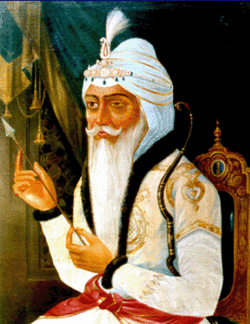
Imagine a warrior so fierce that his name alone kept invaders at bay for centuries. Bappa Rawal, the legendary founder of Mewar, was that hero. Born in a time of chaos, he carved out a kingdom that stood as a beacon of resistance against foreign invasions. This biography dives into the life of Bappa Rawal, exploring his rise to power, epic battles, and enduring legacy. Why does his story matter today? Because it’s a tale of courage and resilience that still inspires.
Early Life & Background
Bappa Rawal, born around 712–713 CE in Anandapura, Rajasthan, entered a world of turmoil. His birth name, Kalbhoja, hinted at his destined greatness. According to the Ekalinga Mahatmya, Bappa was the ninth descendant of Guhadatta, the Guhila dynasty’s founder. Tragedy struck early—his father, Nagaditya, and male kin were killed in a battle against the Bhils of Idar. Orphaned, Bappa was raised in disguise by a Brahmin woman in Nagda, tending sacred cattle.
Legends swirl around his youth. As a spirited prince, he allegedly “married” village girls in a playful game, fleeing to the Vindhya hills to escape their furious parents. These tales paint a picture of a charismatic, bold young man destined for leadership. Under the guidance of Harit Rishi, a revered sage, Bappa embraced Shaivism, shaping his spiritual and martial path.
Ascension to the Throne
By 734 CE, Bappa Rawal’s destiny unfolded. Guided by Harit Rishi, he learned his true identity as a Guhila heir. At age 20, he challenged Maan Mori, the Maurya ruler of Chittor. With strategic brilliance, Bappa defeated Mori, seizing Chittor Fort and establishing the Mewar dynasty. He declared Eklingji (Shiva) as Mewar’s supreme ruler, positioning himself as a divine regent—a tradition that defined Mewar’s rulers.
His coronation marked a turning point. Bappa issued a gold coin featuring a Shivling, symbolizing his devotion and authority. His rule began in Nagda, later shifting to Chittor, cementing Mewar’s foundations.
Resistance Against the Arab Invasions
Bappa Rawal’s reign coincided with the Arab invasions of northwest India, led by figures like Muhammad bin Qasim and Junaid Al Marri. His resistance was pivotal in the Battle of Rajasthan, a series of 8th-century wars that halted Arab expansion. Here’s a closer look at two key campaigns:
The Battle Against Muhammad bin Qasim (c. 725 CE)
Around 725 CE, Muhammad bin Qasim, the Umayyad general, conquered Sindh and eyed Rajasthan. Some accounts suggest Qasim targeted Chittor, then under Mori rule. Bappa, serving as a commander in the Mori army, rallied regional forces. His tactical genius shone as he united smaller states like Ajmer and Jaisalmer, forming a Hindu coalition with allies like Nagabhata I of the Gurjara-Pratihara dynasty.
The battle unfolded near Chittor’s rugged terrain. Bappa’s guerrilla tactics and knowledge of the land outmaneuvered Qasim’s cavalry. After a fierce campaign, Bappa pursued Qasim through Saurashtra, pushing him back to Baluchistan. He established guard posts every 100 kilometers, manned by Rajput chiefs, to deter future invasions. This victory earned Bappa fame surpassing his Mori overlord, paving the way for his takeover of Chittor. Historians debate Qasim’s death (some claim 715 CE), but Bappa’s role in repelling this invasion is celebrated.
[Suggested Image: A dramatic painting of Bappa Rawal leading warriors against Arab invaders. Caption: “Bappa Rawal’s triumph over Muhammad bin Qasim.” Alt Text: Bappa Rawal in battle against Arab invaders]
The Campaign Against Junaid Al Marri (c. 738 CE)
After Qasim’s retreat, Junaid Al Marri, another Umayyad general, launched raids into southern Rajasthan, Malwa, and Gujarat. Bappa, now Mewar’s king, formed a triple alliance with Nagabhata I and Jai Bhatt of Gujarat. The Ekalinga Mahatmya credits Bappa with leading a decisive campaign that drove Junaid beyond Khurasan.
Bappa’s strategy involved rapid cavalry strikes and fortified defenses at Chittor. His army, bolstered by Bhil and Rajput warriors, ambushed Junaid’s forces in the Aravalli hills. The campaign culminated in a crushing defeat for Junaid, with Bappa’s forces pursuing the invaders to western borders. This victory solidified Mewar’s reputation as an impregnable bastion, deterring Arab incursions for nearly 400 years.
Diplomatic Standoffs
Bappa’s diplomacy was as sharp as his sword. He forged alliances with regional powers like the Gurjara-Pratiharas and Chalukyas, creating a united front against external threats. His friendship with Nagabhata I and Jai Bhatt ensured coordinated resistance. Bappa also navigated tensions with the Rashtrakutas, who briefly challenged Mewar’s eastern borders. His diplomatic acumen preserved Mewar’s sovereignty while expanding its influence.
Personal Life
Bappa Rawal’s personal life was as colorful as his conquests. Legends claim he married multiple times, siring over 100 children. His first marriage was to a princess from Nagendra Nagar, cementing local alliances. His progeny, including sons from Hindu and non-Hindu wives, spread his legacy. Some accounts mention his “Yavana” (foreign) sons, possibly linked to conquered territories, as the Naushera Pathans.
Despite his royal duties, Bappa remained a devout Shaivite, spending time in spiritual retreats in Nagda’s hills. His bond with Harit Rishi and devotion to Eklingji defined his character.
Management and Cultural Accomplishments
Bappa’s reign was a golden era for Mewar. He built the iconic Eklingji temple in 734 CE, a masterpiece of Shaivite architecture that remains a pilgrimage site. He patronized poets and scholars, fostering a vibrant court culture. His administration was efficient, with Nagda as the capital until Chittor’s rise. Bappa’s declaration of Eklingji as Mewar’s ruler reflected his innovative governance, blending spirituality with statecraft.
Death and Succession
In 753 CE, at around 39, Bappa Rawal abdicated, retreating to the forests as a Shaivite ascetic. His devotion to Lord Shiva guided this decision, and he lived out his days in spiritual solitude, possibly near Eklingji. He died at a ripe age, leaving a robust kingdom. His son, Khuman I, succeeded him, continuing the fight against Arab incursions.
Legacy
Bappa Rawal’s legacy is monumental. He founded Mewar, a dynasty that endured for centuries, producing heroes like Maharana Pratap. His victories against Arab invaders protected India’s northwest frontier, earning him the title “Hindua Suraj” (Sun of Hindus). The city of Rawalpindi, Pakistan, is said to bear his name, reflecting his far-reaching influence. His Eklingji temple and governance model inspire Rajasthan’s cultural identity today.
Controversies
Bappa’s life isn’t without debate. Some historians question his identity, suggesting “Bappa Rawal” was an epithet for Kalabhoja or Shiladitya due to inconsistent inscriptions. The Atpur inscription (977 CE) omits him, sparking speculation. Others dispute the timeline of his battles, citing discrepancies like Qasim’s death in 715 CE. Yet, his role in repelling invaders remains undisputed, with oral traditions and later inscriptions cementing his legend.