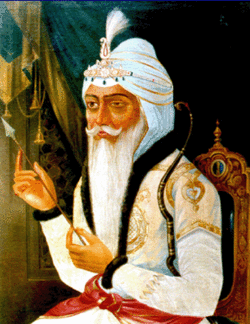
In the heart of 17th-century India, a young warrior king faced an empire that sought to crush his people’s dreams of freedom. Chhatrapati Sambhaji Maharaj, son of the legendary Shivaji Maharaj, stood as a beacon of courage against overwhelming odds. His life, marked by fierce battles, poetic brilliance, and an unyielding spirit, continues to inspire millions. This biography dives into the extraordinary journey of Sambhaji Maharaj, exploring his early struggles, epic wars, and enduring legacy. Why does his story matter? Because it’s a testament to resilience and defiance that still echoes in India’s soul.
Early Life & Background
Born on May 14, 1657, at Purandar Fort, Sambhaji Maharaj was the eldest son of Chhatrapati Shivaji Maharaj and his first wife, Saibai. Tragedy struck early—Saibai died when Sambhaji was just two, leaving him in the care of his grandmother, Jijabai, a formidable influence who instilled in him values of courage and duty. Raised amidst political intrigue and warfare, Sambhaji’s childhood was anything but ordinary. At nine, he was sent as a political hostage to the Mughal court under the Treaty of Purandar, a move to ensure Shivaji’s compliance. This early exposure to the enemy’s world shaped his understanding of power and survival.
Sambhaji was no ordinary prince. Educated by scholars like Keshav Pandit, he mastered Sanskrit, Marathi, and Hindustani, later penning works like Budhbhushanam, a Sanskrit text on politics and military tactics. His intellect was matched by his martial prowess; at 16, he led his first campaign at Ramnagar, proving his mettle. Yet, his youth was also marked by family tensions, particularly with his stepmother Soyarabai, who favored her son Rajaram, sowing seeds of rivalry that would later haunt him.
Ascension to the Throne
Shivaji’s death in 1680 thrust Sambhaji into a storm of intrigue. Soyarabai and her allies plotted to crown Rajaram, but Sambhaji, supported by loyalists like Hambirrao Mohite, seized control of Raigad and Panhala forts. Crowned on July 20, 1680, he became the second Chhatrapati of the Maratha Empire at 23. His ascension was not without bloodshed—conspirators like Annaji Datto were executed for treason, a grim necessity to secure his rule. Sambhaji’s reign began under the shadow of Mughal aggression and internal dissent, setting the stage for his relentless fight for Swarajya.
Movement of Resistance to the Mughal Empire
Sambhaji’s reign was defined by his fierce resistance against the Mughal Empire, led by Emperor Aurangzeb. Unlike his father’s guerrilla tactics, Sambhaji often led from the front, confronting an 800,000-strong Mughal army with a fraction of the resources. His nine-year rule saw 121 battles, all victories, showcasing his strategic brilliance. He disrupted Mughal supply lines, raided their territories, and held strategic forts, keeping Aurangzeb pinned in the Deccan for 27 years. This resistance not only preserved Maratha sovereignty but also protected Hindu kingdoms in North India from Mughal domination.
Diplomatic Standoffs
Sambhaji’s diplomacy was as bold as his warfare. He navigated complex alliances, often clashing with the Portuguese in Goa, who were forcibly converting Hindus and demolishing temples. His campaigns in Konkan aimed to curb their influence, protecting local communities. However, his brief defection to the Mughals in 1678, driven by family disputes, strained relations with Maratha loyalists. Sambhaji later returned, proving his loyalty to Swarajya, but this episode highlighted his complex position between family, allies, and enemies. His diplomatic efforts focused on uniting Maratha factions, though internal betrayals often undermined his plans.
About Wars
Battle of Burhanpur (1681)
The raid on Burhanpur, a wealthy Mughal trade hub, was a masterstroke of Sambhaji’s early reign. In 1681, he led a swift cavalry assault, targeting the city’s riches to fund Maratha campaigns. With meticulous planning, his forces evaded Mughal defenses, plundered the city, and escaped before reinforcements arrived. This raid not only disrupted Mughal commerce but also showcased Sambhaji’s ability to strike deep into enemy territory. The loot strengthened Maratha coffers, enabling further resistance. Historian Govind Sakharam Sardesai notes this as a pivotal moment, highlighting Sambhaji’s strategic daring, though it intensified Aurangzeb’s resolve to crush the Marathas.
Siege of Ramsej (1682–1688)
The six-year Siege of Ramsej was a testament to Maratha resilience under Sambhaji’s leadership. Mughal forces, led by generals like Shahabuddin Khan, besieged the hill fort near Nashik, aiming to choke Maratha defenses. Sambhaji’s troops, outnumbered but spirited, used guerrilla tactics and the fort’s natural defenses to hold out. Supplies were smuggled through secret routes, and Maratha raids disrupted Mughal camps. The siege ended in a stalemate, with the Mughals retreating, unable to break Sambhaji’s resolve. This prolonged defense kept Mughal forces occupied, preventing their advance into Maratha heartlands.
Konkan Campaign (1683–1684)
Sambhaji’s Konkan Campaign targeted the Siddis of Janjira and the Portuguese in Goa. The Siddis, Mughal allies, controlled coastal forts, threatening Maratha trade. Sambhaji’s navy and ground forces launched coordinated attacks, capturing several outposts. Simultaneously, he challenged Portuguese conversions and temple destructions in Goa, aiming to protect Hindu communities. Though he couldn’t capture Janjira, his campaign secured key coastal regions, bolstering Maratha influence. The campaign’s partial success highlighted Sambhaji’s multi-front strategy, though desertions and betrayals limited its impact.
Personal Life
Sambhaji married Yesubai, daughter of Pilaji Shirke, in 1666, a union that strengthened Maratha ties in Konkan. Their son, Shahu, born in 1682, later became Chhatrapati. Sambhaji’s personal life was turbulent, marked by estrangement from his father due to rumors of indiscipline, possibly fueled by Soyarabai’s faction. Despite this, he was a devoted family man, deeply affected by his mother’s early death. His scholarly pursuits, including poetry in Sanskrit and Hindustani, revealed a sensitive side, contrasting his fierce warrior image.
Management and Cultural Accomplishments
Sambhaji’s administration built on Shivaji’s systems, emphasizing justice and revenue efficiency. He maintained the Ashta Pradhan council, ensuring governance continuity. Culturally, he was a patron of the arts, commissioning works like Shambhuraja Charitra by Hari Kavi. His Sanskrit text Budhbhushanam offered insights into statecraft, reflecting his vision for a just kingdom. Sambhaji promoted religious tolerance, protecting diverse communities while opposing forced conversions. His support for Sanskrit scholarship and Maratha traditions enriched the empire’s cultural fabric.
Death and Succession
In February 1689, Sambhaji was betrayed and captured at Sangameshwar by Mughal forces. Tortured for over 40 days, he refused to convert to Islam or surrender Maratha forts. On March 11, 1689, at Tulapur, he was brutally executed—torn apart with tiger claws and beheaded. His death at 31 was a devastating blow, but it galvanized Maratha resistance. His brother Rajaram succeeded him, continuing the fight, with Sambhaji’s widow Yesubai and son Shahu captured by Mughals. His sacrifice became a rallying cry for Swarajya.
Legacy
Sambhaji’s legacy is one of unyielding courage. Known as Dharmaveer, he protected Hindu Dharma and Swarajya against Mughal tyranny. His resistance ensured the Maratha Empire’s survival, paving the way for its expansion under later rulers. Today, his statues dot Maharashtra, and his birth anniversary, May 14, is celebrated as Sambhaji Maharaj Jayanti. His life inspires millions, symbolizing defiance and sacrifice. In Maharashtra, he remains a folk hero, his story retold in literature, films, and plays.
Controversies
Sambhaji’s reign wasn’t without criticism. Historians like Sardesai note his impulsive decisions, such as burning villages to deny supplies to enemies, alienated some Maratha allies. His brief Mughal alliance in 1678 fueled distrust, though he redeemed himself through unwavering loyalty to Swarajya. Rumors of personal vices, possibly exaggerated by rivals, tarnished his image among some contemporaries. Yet, these controversies pale against his sacrifices, with modern narratives emphasizing his heroism over flaws.