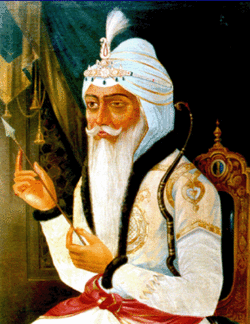
In the heart of ancient India, a warrior king transformed into a beacon of peace, leaving an indelible mark on history. Ashoka the Great, the third emperor of the Mauryan dynasty, ruled from 268 to 232 BCE, commanding an empire that stretched from modern-day Afghanistan to Bangladesh. His journey from a ruthless conqueror to a compassionate ruler, inspired by Buddhism, captivates historians and readers alike. Why does Ashoka’s story matter today? His radical shift toward nonviolence and tolerance offers timeless lessons in leadership and humanity. Dive into this biography to uncover the secrets of his transformative reign.
Early Life & Background
Born around 304 BCE in Pataliputra (modern-day Patna), Ashoka was the grandson of Chandragupta Maurya, founder of the Mauryan Empire, and son of Emperor Bindusara. His mother, Subhadrangi, was of humble origin, which some sources suggest fueled Ashoka’s fierce ambition. Known as a skilled warrior and administrator, young Ashoka was sent to govern Ujjain, where he honed his leadership skills. Buddhist texts paint him as a fiery youth, earning the moniker “Chandashoka” (Ashoka the Cruel) due to his temper. Yet, his early exposure to diverse philosophies, including Jainism and Buddhism, planted seeds for his later transformation.
Ascension to the Throne
Ashoka’s rise to power was anything but smooth. Following Bindusara’s death in 272 BCE, a brutal war of succession erupted among his sons. According to Buddhist texts like the Mahavamsa, Ashoka allegedly killed 99 of his half-brothers to secure the throne, sparing only his brother Vitashoka. While these accounts may be exaggerated, they underscore Ashoka’s ruthless determination. By 268 BCE, he was crowned emperor in Pataliputra, inheriting a vast but turbulent empire. His early reign leaned heavily on the Arthashastra, a treatise by Chanakya, emphasizing strong governance and military might.
Wars of Ashoka: The Path to Transformation
The Kalinga War: A Bloody Turning Point
Around 261 BCE, Ashoka launched a campaign against Kalinga (modern-day Odisha), a prosperous coastal kingdom with a formidable navy. The Edicts of Ashoka vividly describe the war’s devastation: over 100,000 soldiers and civilians perished, and 150,000 were deported. Ashoka himself walked the battlefield, witnessing the carnage—mangled bodies, grieving families, and ruined cities. This visceral horror shattered his warrior ethos. Deeply shaken, he embraced Buddhism under the guidance of monk Moggaliputta Tissa, renouncing violence. The Kalinga War became the catalyst for his policy of “Dhamma” (righteous conduct), prioritizing compassion and nonviolence. This shift didn’t erase his military past but redirected his focus to cultural and spiritual expansion.
Earlier Conquests: Building an Empire
Before Kalinga, Ashoka’s early reign was marked by aggressive expansion. He subdued revolts in Taxila and annexed regions from Afghanistan to Assam, covering the Gangetic plains and parts of South India. Unlike Kalinga, these campaigns are less documented, but inscriptions suggest they were swift and brutal, consolidating Mauryan dominance. Ashoka’s military prowess, honed in Ujjain, ensured victories, but at a cost. Cities were razed, and populations subdued, earning him fear rather than loyalty. These conquests, while expanding the empire, set the stage for his later remorse, as he reflected on the human toll of his ambition.
Diplomatic Standoffs
Ashoka’s post-Kalinga reign saw a shift from conquest to diplomacy. His edicts reveal diplomatic missions to regions like Syria, Greece, and Sri Lanka, where he sent emissaries, including his children Mahinda and Sanghamitta, to spread Buddhism. These efforts weren’t about dominance but mutual respect, fostering cultural exchange. He maintained peace with neighboring kingdoms, avoiding conflicts with the Seleucid Empire in the west. His policy of tolerance allowed diverse faiths—Jainism, Brahmanism, and Buddhism—to coexist, a rare feat in ancient empires. This diplomatic finesse strengthened the Mauryan Empire’s global influence without bloodshed.
Personal Life
Ashoka’s personal life is shrouded in mystery, pieced together from inscriptions and Buddhist texts. He married several times, with notable wives including Asandhamitra, a devout Buddhist, and Devi, mother of his children Mahinda and Sanghamitta. Despite his royal status, Ashoka’s edicts reveal a paternal side, declaring, “All men are my children.” His commitment to animal welfare—banning sacrifices and establishing veterinary hospitals—reflected his empathy. Yet, his early reputation as a ruthless ruler lingered, with tales of a torture chamber dubbed “Ashoka’s Hell.” These contradictions paint a complex man, balancing power with newfound compassion.
Management and Cultural Accomplishments
Ashoka’s governance was revolutionary. He centralized administration, appointing governors to provinces like Taxila and Ujjain, while decentralizing power at village levels. His Dhamma policies promoted ethical conduct, encouraging virtues like honesty, compassion, and nonviolence. He built hospitals, schools, and roads, ensuring public welfare. His architectural legacy includes the Sarnath Lion Capital, now India’s national emblem, and thousands of stupas, like the one at Sanchi. These structures, inscribed with his edicts, spread Buddhist teachings and preserved his vision. Ashoka’s patronage of the Third Buddhist Council in 247 BCE solidified Buddhism’s global reach.
Death and Succession
Ashoka died around 232 BCE, likely in Pataliputra. His later years were marked by declining health and a focus on spiritual pursuits. The Mauryan Empire fragmented soon after, as his successors lacked his vision. His grandson Dasharatha briefly ruled, but the empire crumbled by 185 BCE. Buddhist texts suggest Ashoka’s death was peaceful, surrounded by monks and family. His absence left a void, and his Dhamma policies waned, though his edicts endured, rediscovered centuries later by British scholar James Prinsep.
Legacy
Ashoka’s legacy transcends time. His edicts, carved on rocks and pillars, are among India’s oldest surviving texts, offering insights into his philosophy. The Ashoka Chakra, a 24-spoke wheel, adorns India’s flag, symbolizing righteousness. His embrace of nonviolence inspired leaders like Mahatma Gandhi and Martin Luther King Jr. Globally, his role in spreading Buddhism to Sri Lanka, Southeast Asia, and beyond cemented his influence. Yet, modern scholars debate his saintly image, noting he never disbanded his army and maintained control through force when needed. This duality—warrior and peacemaker—makes Ashoka a compelling figure.
Controversies
Ashoka’s early brutality casts a shadow over his legacy. Buddhist texts like the Ashokavadana claim he killed his siblings to seize power, though historians question the extent of this violence. His “Ashoka’s Hell” torture chamber, described in Sri Lankan chronicles, paints a grim picture of his pre-Buddhist days. Even post-conversion, some argue his Dhamma was a political tool to unify a diverse empire, not pure altruism. Critics also note that he didn’t return Kalinga to its people or free the deported, raising questions about the depth of his transformation. These controversies remind us that Ashoka, while great, was human.