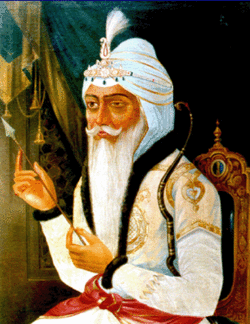
In the rugged hills of the Deccan, a young warrior named Shivaji Maharaj carved a legacy that echoes through India’s history. Born in 1630, he defied the mighty Mughal Empire, creating a Maratha stronghold through courage and cunning. This biography uncovers the life of Chhatrapati Shivaji Maharaj, a symbol of resistance and strategic brilliance. Why does his story matter today? His leadership, rooted in justice and innovation, inspires modern India. Join us to explore his journey, battles, and enduring impact, revealing secrets that shaped a nation.
Early Life & Background
Shivaji Bhonsle was born on February 19, 1630, at Shivneri Fort in Maharashtra, to Shahaji Bhonsle, a Maratha general, and Jijabai, a devout and influential figure. Raised amidst political turmoil, young Shivaji grew up hearing tales of valor and independence. Jijabai instilled in him a fierce sense of dharma and pride in his Maratha heritage. By his teens, he was trained in warfare and administration, showing early signs of leadership. His upbringing in the rugged Sahyadri mountains shaped his guerrilla tactics, later a hallmark of his military genius.
Ascension to the Throne
Shivaji’s rise began in 1645 when, at just 15, he captured the Torna Fort, marking his first conquest. By 1659, he had consolidated power, defeating Adilshahi forces and establishing a Maratha base. His coronation in 1674 at Raigad Fort as Chhatrapati was a bold declaration of sovereignty. Unlike other rulers, Shivaji’s rule was grounded in Swarajya (self-rule), emphasizing local governance and cultural pride. His administration was revolutionary, with a council of eight ministers (Ashtapradhan) ensuring efficient governance.
Movement of Resistance to the Mughal Empire
Shivaji’s resistance against the Mughal Empire, led by Aurangzeb, defined his legacy. He used guerrilla warfare, leveraging the Deccan’s terrain to outmaneuver larger armies. His raids on Mughal outposts, like the 1664 Surat plunder, disrupted their economic stronghold. Shivaji’s vision of Swarajya challenged Mughal dominance, inspiring local support. His navy, one of India’s first, protected coastal trade routes, further weakening Mughal control. This movement wasn’t just military—it was a cultural and political awakening.
Diplomatic Standoffs
Shivaji’s diplomacy was as sharp as his sword. His 1666 visit to Aurangzeb’s court in Agra was a masterclass in courage. Trapped and placed under house arrest, he escaped using wit, hiding in fruit baskets. His treaties with the Adilshahi and Qutb Shahi rulers balanced power dynamics, ensuring Maratha survival. Shivaji’s ability to negotiate while maintaining his principles earned him respect and fear, making him a formidable player in India’s political landscape.
About Wars
Battle of Pratapgad (1659)
The Battle of Pratapgad was a defining moment in Shivaji’s resistance against the Adilshahi dynasty. General Afzal Khan, sent to crush the Maratha uprising, marched with a massive army of 10,000. Shivaji, with only 7,000 troops, lured Khan into the dense forests of Pratapgad Fort. On November 10, 1659, during a diplomatic meeting, Khan attempted to assassinate Shivaji, but the Maratha leader was prepared. Armed with a concealed tiger claw, Shivaji killed Khan and signaled his troops. The Marathas ambushed the Adilshahi forces, using guerrilla tactics to exploit the terrain. The victory secured Javli’s strategic valley and boosted Shivaji’s reputation. Losses were minimal for the Marathas, while the Adilshahi army was decimated, marking a turning point in Shivaji’s campaign for Swarajya.
Battle of Pavan Khind (1660)
Following Pratapgad, the Adilshahi forces regrouped under Siddi Johar, besieging Panhala Fort in 1660. Shivaji, trapped inside, planned a daring escape. On a stormy night, he fled with 600 men, pursued by a larger enemy force. At Pavan Khind, a narrow pass, Baji Prabhu Deshpande and 300 Marathas held off thousands to ensure Shivaji’s safety. Baji Prabhu’s sacrifice, fighting until he heard Shivaji’s signal of safety, turned the pass into a legend of loyalty. The Marathas lost 300 men, but Shivaji escaped, regrouping to recapture Panhala later. This battle showcased Maratha resilience and strategic sacrifice.
Battle of Sinhagad (1670)
The Battle of Sinhagad was a testament to Maratha valor. The Mughal-controlled Sinhagad Fort, perched on a steep hill, seemed impregnable. Shivaji tasked Tanaji Malusare with its recapture. On February 4, 1670, Tanaji’s men scaled the cliffs at night using monitor lizards to anchor ropes. A fierce battle ensued, with Tanaji personally leading the charge. Despite heavy losses, including Tanaji’s death, the Marathas triumphed, reclaiming the fort. Shivaji’s famous words, “The fort is won, but my lion is gone,” immortalized Tanaji’s sacrifice. This victory strengthened Maratha control over key territories.
Battle of Surat (1664)
Shivaji’s raid on Surat, a wealthy Mughal port, was a bold economic strike. In January 1664, he led 4,000 cavalrymen to plunder the city, avoiding direct confrontation with Mughal forces. The raid lasted four days, targeting wealthy merchants and Mughal treasuries. Shivaji’s men looted goods worth crores, crippling Mughal finances. The Marathas faced minimal resistance, as the Mughal governor fled. This audacious attack showcased Shivaji’s strategic foresight, using economic disruption to weaken his enemies while funding his growing empire.
Personal Life
Shivaji married multiple times, with Saibai being his chief consort. His eight wives included Putalabai and Sakvarbai, reflecting alliances with influential Maratha families. He had eight children, including Sambhaji, his successor, and daughter Sakhubai. Despite his warrior image, Shivaji was a devoted family man, ensuring his children’s education and welfare. His personal life balanced duty and devotion, with Jijabai’s influence shaping his values. Shivaji’s respect for women was evident in his strict orders against harming civilians during campaigns.
Management and Cultural Accomplishments
Shivaji’s administration was ahead of its time. His Ashtapradhan council decentralized power, with roles like the Peshwa (prime minister) ensuring efficiency. He promoted Marathi and Sanskrit over Persian, reviving cultural identity. His forts, like Raigad and Sindhudurg, were architectural marvels, blending defense with aesthetics. Shivaji’s naval innovations protected trade routes, boosting the economy. He abolished oppressive taxes, earning loyalty from peasants. His patronage of arts and religion fostered a cultural renaissance, making the Maratha Empire a beacon of indigenous pride.
Death and Succession
Shivaji died on April 3, 1680, at Raigad Fort, likely from illness, at age 50. His death shocked the Maratha Empire, but his son Sambhaji ascended the throne. Sambhaji faced immediate challenges, including Mughal aggression and internal dissent. Despite early struggles, he continued Shivaji’s policies, though his reign was marred by betrayal and capture by the Mughals in 1689. Shivaji’s groundwork ensured the Maratha Empire’s survival, with his successors expanding its reach.
Legacy
Chhatrapati Shivaji Maharaj’s legacy is monumental. He laid the foundation for the Maratha Empire, which resisted Mughal rule for over a century. His forts, over 300, remain symbols of resilience. Modern Maharashtra celebrates him through festivals, statues, and institutions like the Shivaji University. His emphasis on Swarajya inspires India’s federal ethos. Globally, historians admire his guerrilla tactics, studied in military academies. Shivaji’s life embodies courage, strategy, and cultural pride, making him a timeless icon.
Controversies
Shivaji’s life wasn’t without debate. Some Mughal chroniclers labeled him a rebel, accusing him of plundering without cause. His raid on Surat drew criticism for targeting civilians, though evidence suggests he focused on Mughal elites. Modern debates question his alliances with rival kingdoms, seen by some as pragmatic, others as opportunistic. Caste-based narratives occasionally emerge, with critics arguing his Maratha focus sidelined other communities. Yet, his inclusive policies, like appointing diverse officials, counter these claims. These controversies, often amplified by political agendas, don’t dim his stature.