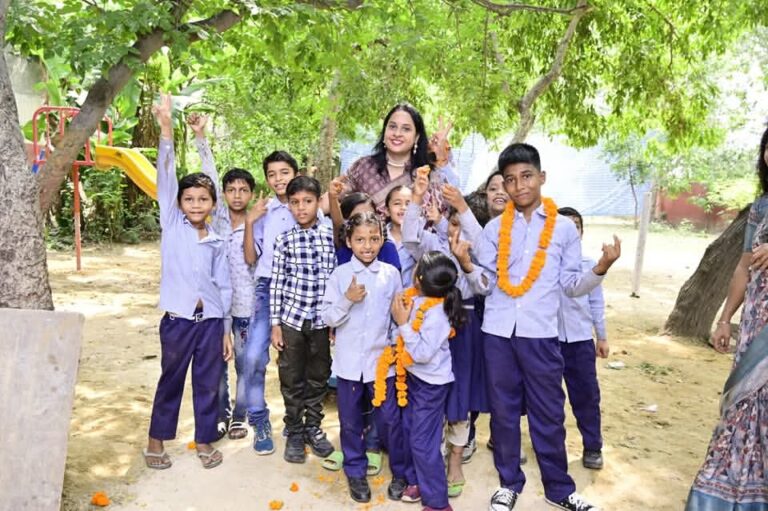
Kailash Satyarthi’s life is a testament to the power of compassion in action. At just five years old, he saw a boy his age toiling as a cobbler outside his school in Vidisha, India, and asked why he wasn’t in class. The answer—that some children are “born to work”—ignited a lifelong mission to end child labor and secure education for all. As a 2014 Nobel Peace Prize co-recipient, Satyarthi has freed over 138,000 children from exploitation. This biography explores why his fight for child rights matters for a just world.
Early Life
Born Kailash Sharma on January 11, 1954, in Vidisha, Madhya Pradesh, Satyarthi grew up in a middle-class family as the youngest of four brothers and a sister. His father, Ramprasad Sharma, was a retired police head constable, and his mother, Chironjibai, an uneducated housewife, instilled in him a deep sense of morality. Living in a diverse neighborhood where Hindus and Muslims coexisted, young Kailash learned Urdu from a local Maulvi at age four, alongside Hindi and English at school. His mother’s idealism shaped his empathy, evident when, at 11, he organized a soccer club to fund school fees for underprivileged peers.
Education
Satyarthi pursued a degree in electrical engineering from Samrat Ashok Technological Institute in Vidisha, graduating in 1974, followed by a postgraduate diploma in high-voltage engineering. He briefly taught at a college in Bhopal but felt a pull toward social justice. Influenced by the Arya Samaj movement, which rejected caste hierarchies, he abandoned his Brahmin surname, Sharma, adopting “Satyarthi,” meaning “seeker of truth.” This marked his shift from engineering to activism, driven by a belief that education is every child’s right.
Career
In 1980, Satyarthi founded the Bachpan Bachao Andolan (BBA), or Save the Childhood Movement, to combat child labor in India. BBA’s confrontational approach involved raiding factories, often with police, to liberate children from bonded servitude. Despite facing violent attacks and the loss of colleagues, Satyarthi’s team has rescued over 138,000 children, providing rehabilitation through ashrams like Mukti and Bal Ashram. In 1998, he led the Global March Against Child Labour, an 80,000-km trek across 103 countries, sparking global awareness and influencing the International Labour Organization’s Convention 182 against the worst forms of child labor.
He also established GoodWeave International (formerly Rugmark) in 1994, certifying child-labor-free rugs and promoting ethical trade. The Kailash Satyarthi Children’s Foundation (KSCF), founded in 2004, advocates for child protection policies worldwide. His 2001 Shiksha Yatra, a 15,000-km march, helped secure India’s Right to Education Act in 2009, a landmark for free education.
Personal Life
Satyarthi’s personal life reflects his commitment to truth and justice. After marrying, he embraced the Arya Samaj’s reformist ideals, renouncing caste-based traditions. His family life remains private, but his work is deeply personal, inspired by his mother’s compassion and his own encounters with injustice, like seeing children sold to repay debts. Satyarthi’s resolve was further hardened in 1988 when he challenged a 400-year-old discriminatory practice at the Shrinathji temple, opening its doors to Dalits.
Awards and Honors
Satyarthi’s relentless advocacy has earned him numerous accolades:
- 2014 Nobel Peace Prize, shared with Malala Yousafzai, for their fight for children’s education rights.
- Robert F. Kennedy Human Rights Award (1995) for advancing human rights.
- Medal of the Italian Senate (2007) and Alfonso Comín International Award (2008) for his global impact.
- Honorary Doctorates from universities like Amrita University (2022) and Lynchburg College (2016).
His Nobel medal, dedicated to India, is displayed at the President’s House Museum in New Delhi.
A Movement Beyond Borders
Satyarthi’s influence extends globally through initiatives like the Global Campaign for Education and the 100 Million campaign, launched in 2016 to mobilize youth against child labor. His work shaped the UN’s Sustainable Development Goals, earning him the title of SDG Advocate in 2021. Despite facing life-threatening attacks, Satyarthi’s non-violent approach, inspired by Mahatma Gandhi, continues to inspire millions. His 2017 Bharat Yatra against child trafficking led to stronger Indian laws against child sexual abuse.
Philanthropy
Kailash Satyarthi’s journey from a small-town engineer to a Nobel laureate shows that one person’s compassion can change millions of lives. His fight against child labor and for education rights challenges us to rethink what’s possible when we act with purpose. His movement reminds us that every child deserves freedom and a future. Learn more about his work at the Kailash Satyarthi Children’s Foundation or share your thoughts on how we can globalize compassion today.