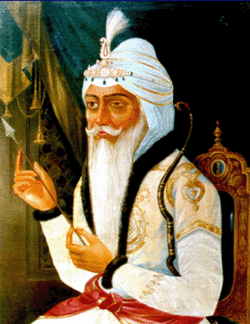
Maharana Pratap Singh Sisodia (9 May 1540 19 January 1597), commonly called Maharana Pratap, was a Hindu Rajput ruler of Kingdom of Mewar in north-western India, today the state of Rajasthan. He was the 54th reigning monarch of the Sisodia dynasty and ruled in the reign of 1572 to 1597 and is praised to have lived under indomitable spirit, steadfast resistance to the Mughal Empire during the reign of Emperor Akbar and his incapacitated efforts to retain the sovereignty of Mewar. His legacy of life which was and is marked by such epic battles as the Battle of Haldighati, guerrilla warfare and personal sacrifices has made him an ice of Rajput heroism, Indian patriotism and defiance of foreign rule. The epic of Maharana Pratap is strewn with chivalry and an touch of honor, and through Rajasthani folklore, historical facts and cultural memories has laid himself as one of the most honored historical people of India in many centuries.
Early Life & Background
Maharana was born to Maharana Udai Singh II, the ruler of Mewar, and Rani Jaiwanta Bai Songara who was princess of the Songara Chauhan clan, on 9 May 1540 beyond the walls of Kumbhalgarh fort, a commanding stronghold situated in the heart of Aravalli hills of Rajasthan. As his father, Udai Singh, had twenty-five sons, Pratap grew up knowing what was expected of him, that is, he was to succeed his father and become a ruler of Mewar, a kingdom with a long and very strong history of independent culture and the king. His mother, Jaiwanta Bai, taught him courage, duty and devotion to dharma and his father court introduced him to the problems of running a kingdom that was under constant attack by neighbouring kingdoms.
Pratap was raised in a flashy period as the kingdom of Mewar struggled with outside interference of the growing Mughal Empire and power struggles between Rajput clans. His brothers were younger brother Shakti Singh, Vikram Singh and Jagmal Singh, and his stepsisters Chand Kanwar and Man Kanwar. Since his early days, Pratap was drilled in martial arts, which included archery, swordplay, using a spear, riding a horse with great proficiency and in time to come, became the characteristics of his military career. He was also trained in literature, music and The Hindu scriptures especially the Ramayana and Mahabharata which influenced his spirituality and adherence to the right.
At the age of 27, Pratap had his turning point encounter, in the year 1567, when the then Mughal Emperor Akbar besieged the historic capital of Mewar, Chittorgarh. The Third Siege of Chittorgarh (15671568) was a violent one and Akbars army overran the defenders of the fort. Although Pratap wanted to engage in battles, he was convinced by Udai Singh and the nobles to accompany the royal family to the evacuation so that the Sisodia dynasty would not be washed away. The sack of Chittorgarh with the concomitants of the doleful jauhar (self-immolation) of thousands of Rajput women, that they might not fall into the hands of their enemies produced a profound impression on Pratap. Royal family moved to Gogunda and Udai Singh set up a temporary Government there. This experience toughened Pratap to struggle against the Mughal rule, and restore the glory of Mewar.
Ascension to the Throne
The death of Udai Singh II in 1572 provoked a tortuous transition of power in Mewar. This time influenced by his favorite queen Rani Dheer Bai Bhatiyani, Udai Singh handed over the succession instead of his eldest son Pratap to his younger son Jagmal on the advice of his queen Rani Dheer Bai Bhatiyani. This move provoked outrage on the senior nobles of Mewar, especially the Chundawat Rajputs who admired Pratap as their ruler and Royal Military and as one complying with the Rajput traditions. It happened quite dramatic that Pratap had carried the remains of his father to the cremation in the city and Jagmal managed to ascend the throne of Gogunda temporarily. The nobles however kicked off the door headed by Rawat Krishnadasji Chundawat and put a check on Jagmal claiming he could not qualify as a ruler and he had to abdicate. On 1 March 1572 Pratap was crowned Maharana in a massive procession at Gogunda, and it was the time of the Holi Purnima when renewal and strength were called upon.
Dissatisfied at having been defeated, Jagmal crossed over to the Mughal camp and Akbar gave him the town of Jahazpur as a jagir (grant of land). When Pratap was betrayed it increased the rift between Pratap and Mughals and this lead to life long struggle. The coronation of Pratap formed the start of a reign of defiance, however, because he acquired a kingdom that had been devastated by its defeat at Chittorgarh and was balanced by Mughal-friendly Rajput states such as Amer and Bikaner along with Jodhpur.
Movement of Resistance to the Mughal Empire
When Maharana Pratap assumed power, he had to deal with the powerful Mughal Empire of Akbar who was trying to expand his power to northern India. Pratap followed no Rajput ruler who had accepted the Mughal suzerainty in order to get rich and rank; instead, he valued Mewar and was not ready to submit to the Mughals as it would mean he was betraying his forefathers and the Rajput self esteem (आन-बान-शान) The form of resistance adopted by him was diplomatic defiance, pitched battles as well as prolonged guerrilla warfare which made him a legendary figure in Indian history.
Diplomatic Standoffs
During April to October 1573, Akbar dispatched six diplomatic missions to Mewar led by such well-known persons as Jalal Khan Qurchi, Raja Man Singh I of Amer, Raja Bhagwant Das, Todarmal, Raja Rai Singh of Bikaner and Raja Ram Chandra. These envoys told Pratap that he should pay tribute to Mughal and they would provide him with peace, prosperity and marital relations and agreed to give Pratap, peace, prosperity and marital relations in hope. Pratap did not accept any of them because he did not want to weaken the sovereignty of Mewar. Historical evidence, Rajsamand Inscription and Vansh Bhaskar of Bikaner indicate that Pratap denied acceptance on the basis of Hindu pride and Rajput freedom.
One of the incidents was when Raja Man Singh came. Rajput records, such as the Amar Kavya allege that Pratap offended Man Singh by refusing to share his dinner table on the basis of Man Singh having connections to the Mughals. Although historians like Rima Hooja have doubted the accuracy of this account; there is an argument that this is a statement of contempt of Pratap at the Rajputs who joined with Akbar. The next controversy was when Akbar ordered Pratap to give his favorite elephant, Ram Prasad who was the esteem of Mewar. The tension rose because Pratap refused to give up on elephant and this would indicate that he was defiant. Diplomacy broke down by the end of 1573 and Akbar was ready to take military steps.
Haldighati battle
Pivotal action Pratap A decisive battle where Pratap successfully challenged the Mughals was fought on 18 June 1576 at a place called Haldighati in a narrow pass near Gogunda in modern Rajsamand in the state of Rajasthan. Pratap commanded about 3,000 mounted soldiers, 400 Bhil archers and 1,200 infantry including allies Ram Shah Tanwar of Gwalior, Chandrasenji Rathore of Marwar, with chiefs like Rawat Krishnadasji Chunda and Maan Singhji Jhala. Raja Man Singh I and Asaf Khan led the Mughal army that consisted of about 10,000 soldiers including Mughal troops and contingents of India Rajputs of Amer, Bikaner and Bundi.
It was a four hours intense battle in which Pratap forces used geography to their benefit. In leading a charge at the head of a cavalry, Pratap charged at Man Singh who was in his howdah. His trusty steed, Chetak, was also instrumental, and it would dash around going over the barriers to put Pratap in range of the Mughal leader. The Mughal forces were, however, numerically strong that overpowered the army of Mewar. Pratap was hurt, and Chetak an elephant gave him a mortal thrust, with his trunk-sword, on the hind leg. Maan Singhji Jhala put on the royal insignia of Pratap as a shield and in a heroic act he gave his own life so that Pratap could escape. After crossing a brook which was 26 feet in breadth, Chetak collapsed not far from Balicha village with Pratap. The Mughals prevailed with a lot of spoils (Ram Prasad taken prisoner and about 1,600 Mewar soldiers killed as compared to 350 Mughal soldiers and 150 wounded). But they did not capture Pratap or his family which made this win not quite strategic.
Guerilla Warfare and reconquest
Following Haldighati Pratap went back to the Aravalli hills, and went into guerrilla tactics to cull Mughal outposts and mess with their hold on Mewar. Being exiled with his own family, he was dependant on the help of the Bhil and other tribes, who were giving them shelter, supplies and information. His faithful servant(Bhama Shah), a Jain merchant, gave his own resources to finance Pratap in his battles that allowed him to have an army and provide supplies. Pratap used guerilla warnfare in form of ambush, night attacks, and sabotage, that put the Mughals in nervous state thus they could not secure their grip over Mewar.
In 1582 Pratap took advantage of the Mughal preoccupations in Punjab, Bengal and Bihar with a blitz attack. At the Battle of Dewair (1582), on the Dewair pass, Pratap himself led an army against a Mughal force under Sultan Khan, and utterly routed it. Requiring only three days, Pratap took 36 of the Mughal outposts such as Kumbhalgarh, Udaipur, Amet and Mandal and regained most of western Mewar, without Chittorgarh and Mandalgarh. This success which Colonel James Tod called the Marathon of Mewar demonstrated the tactical genius of Pratap and this earned Pratap the title of Leonidas of Rajasthan. He founded a new capital at Chavand lying near Dungarpur and fortified it to launch subsequent campaigns.
In 1585, Kumbhalgarh and other forts were recaptured by Akbar forces whose leader Jagannath Kachwaha briefly recaptured Kumbhalgarh but Pratap raids forced their retreat. In the late 1580s, Pratap restored a substantial portion of Mewar; he was then consigned to his place in history as a determined warrior-king who resisted what would be one of the most powerful empires ever, in the late 16th century.
Personal Life
Maharana Pratap took eleven wives which was a Rajput legacy that symbolized political marriages with the property of the ability. He was married to his primary consort at the age of 17 in 1557 named Maharani Ajabde Punwar of Bijolia. Ajabde was fruitful and clever and the trusted adviser of Pratap being his mother who gave him his eldest son Amar Singh I who took over the empire. Other wives of Pratap were such as Phool Kanwar Rathore, Champa Bai and Jasoda Bai. He had seventeen sons and five daughters many of whom served the administration of the state of Mewar and in the campaigns.
The relationship between Pratap and his steed Chetak is a legend. Chetak was a Kathiawari breed, famous in his speed, loyalty, and courage. The Battle of Haldighati proved to be a dramatic event where most important aspect was the heroic jump which is made by Chetak in order to save life of Pratap hence, becoming legend of devotion in the folk traditions of Rajasthan. Haldighati has a memorial, the Chetak Smarak, to the sacrifice of the horse.
Physically Pratap was a giant with him being about 7 feet 5 inches tall and 110 kg in weight. He carried a shield and 2 swords weighting 208 kg, an 81-kg spear and had armor on his body. The two swords together weigh 25 kg and can be taken as evidence of his physical prowess and power, being kept in the Government Museum in Udaipur. Pratap was also a very religious Hindu, who was a strong follower of the Ramayana and the dharma. His veneration to preserve the Hindu pride and the Rajput honor found a chord with his subjects who took him as a savior of their cultural and religious identity.
Management and Cultural Accomplishment
Pratap was able to have an efficient government in Mewar despite the constant threat of war. He refounded the kingdom upon organizing the administration of his domain locating Chavand as his capital and depending on faithful nobles and tribal supporters to regulate resources and support order. His government was based on justice, loyalty, and welfare of his subjects most of whom also suffered with him during his exile.
Pratap was a patron of arts, and supported the growth of the school of art in Chavand, a branch of miniature painting art of Mewar. The school also gave the foremost expressions of courtly life and battles and religions that were symbolic of the survival of cultural identity of the incomparable kingdom of Mewar. Pratap also helped the poets and the scholars because even though the land of Mewar was going through some hardships, the literary treasures did not die down. His support of Bhil and other tribal people enhanced the social welfare of the state of Mewar and built a conglomeration of forces loyal to the Sisodia history and heritage.
Death, Succession
At the age of 56, Maharana Pratap expired on 19 January 1597 in Chavand. According to historical records, he died of an infection on his leg possibly caused by a hunting incident that his injuries incurred when his horse threw him had fuelled. Pratap failed in regaining Chittorgarh in his lifetime, a loss which he lamented of on his deathbed. He was succeeded by his son Amar Singh I who fought on to 1614 before he finally surrendered to Emperor Jahangir on a treaty which left Mewar as an autonomous region.
Full Rajput honors were given to the funeral of Pratap and his traditions were eternalised through oral literature and written chronicles. His death did spell the end of an era, however through resistance of Mewar and cultural memory his spirit of defiance remained wedded to his presence.
Legacy
The culture and the history of India have a symbol of resistance (and patriotism) that is the legacy of Maharana Pratap. He is a hero in Rajasthan and further on because he refused to bow down to the Mughal authority despite personal sufferings. He is appreciated by the creation of ballads, folk songs and stories that emphasize his courage, the loyalty of Chetak and the sacrifices of his followers. Maharana Pratap Memorial in Udaipur consists of a bronze statue of Pratap riding Chetak, a pilgrimage destination of those who take their inspiration in his legacy.
The birth anniversary of Pratap is a public holiday celebrated on the Tritiya tithi of Jyeshtha Shukla Paksha (usually in May or June) throughout the state of Rajasthan, Haryana and Himachal Pradesh and is marked with processions and cultural events and tributes. To maintain his legacy into the future generations, a museum called the Pratap Gaurav Kendra was created in Udaipur, which exhibits artifacts, paintings and models of his weapons.
The contributions of Pratap are found in the accounts of other historians such as Colonel James Tod, in his Annals and antiquities of rajasthan, modern historians such as Rima Hooja and Satish Chandra. His guerilla assaulting style became one that contemporary Indian resistance efforts would learn and his life is still inspiring signs of nationalistic movements.
Controversies
There is still a debate to the outcome of the battle of Haldighati. Abu Fazl in his Akbarnama is Mughal sources of history as well as historians like Satish Chandra term it Mughal Victory, and Pratap fled to the hills. Rajasthani texts, such as a voice of Amar Kavya and oral tradition, though, maintain that Pratap survived and continued fighting, thus making the conquest meaningless. In 2017, BJP MLA Mohan Lal Gupta and other politicos called on the government to change school textbooks to describe Haldighati as a moral victory of Pratap, however there was a backlash. Such revisions were lamented by historian Tanuja Kothiyal attributing to the political nature of history and fatally flawed academic integrity.
The lives of Pratap and his relationships with those Mughal-oriented allies of Rajputs such as Raja Man Singh are another controversial issue. Although other sources portray Pratap as arrogant or antagonistic, they also indicate that such behaviours were portrayed in exaggerated terms as a way of glorifying his defiance. These arguments show the intricate interaction between history, politics and regional pride in the accounts of the life of Pratap.
In Popular Culture.
The life of Maharana Pratap has been written in many books, movie, TV program and cultural materials. Well-known depictions are: Literature: Maharana Pratap:
- The Legendary Rajput Warrior of Anil Kumar Salil and Annals and Antiquities of Rajasthan of Colonel James Tod.
- Television: His life was dramatized under the title Bharat Ka Veer Putra -Maharana Pratap (20132015).
- Motion pictures: He has been depicted as heroic in a 1946 film Maharana Pratap and the regional films.
- Folklore Rajasthani ballads, most notably those sung by the Bhil community, glorify the exploits of Pratap and Chetak, usually with poetic flourishes.
- Monuments: Government Museum, Udaipur, and Chetak Smarak at Haldighati are exhibiting replicas of the swords of Pratap and it is visited by thousands of people every year.
- The story of Pratap is also enforced in the curricula of school, patriotic writings, and cultural events which further testifies to his reputation as a national icon.