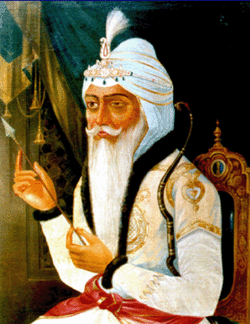
In the heart of 12th-century India, a young warrior king rose to challenge invaders with unmatched courage. Prithviraj Chauhan, often hailed as the last Hindu emperor, was only 11 when he inherited a kingdom under threat. His life, a tapestry of valor, romance, and tragedy, continues to captivate historians and storytellers alike. This biography delves into the saga of Prithviraj Chauhan, exploring his rise, battles, and enduring legacy. Why does his story matter today? It’s a timeless reminder of resilience against overwhelming odds.
Early Life & Background
Born around 1166 CE in Ajmer, Rajasthan, Prithviraj Chauhan was the son of King Someshvara Chauhan and Queen Karpuradevi, a Kalachuri princess. From a young age, he displayed extraordinary talent, mastering military skills and archery. Legends claim he could hit targets by sound alone, a skill that would later define his battlefield prowess. Raised in the Chauhan dynasty, Prithviraj was groomed for leadership, educated in warfare, governance, and poetry. His early exposure to the turbulent politics of medieval India shaped his ambition to expand his kingdom and defend his people.
Ascension to the Throne
At just 11, Prithviraj ascended the throne in 1177 CE after his father’s death. His mother served as regent, guiding the young king with loyal ministers like Kadambavasa. Despite his youth, Prithviraj quickly asserted control, quelling a rebellion by his cousin Nagarjuna, who seized the Gudapura fortress. His decisive victory showcased his military genius. By 1180, he ruled a kingdom stretching from Thanesar to Jahazpur, laying the foundation for his reputation as a formidable leader. His capital, Ajmer, became a hub of power and culture.
Movement of Resistance to the Mughal Empire
The Mughal Empire would not emerge until centuries later, but Prithviraj faced a similar threat from the Ghurid dynasty, led by Muhammad of Ghor. His resistance against foreign invasions became legendary. In 1191, he united Rajput kings to confront Ghori’s forces, marking a pivotal stand against Islamic conquests. His victories, especially in the First Battle of Tarain, symbolized Hindu resistance. Yet, internal rivalries among Rajput rulers weakened his alliances, a recurring challenge that shaped his reign.
Diplomatic Standoffs
Prithviraj’s diplomacy was as bold as his sword. His rivalry with Jayachandra of the Gahadavala kingdom in Kannauj was particularly intense. According to the epic Prithviraj Raso, Jayachandra’s refusal to acknowledge Prithviraj’s supremacy led to a dramatic standoff. Prithviraj’s alleged elopement with Jayachandra’s daughter, Sanyogita, fueled their enmity. While some historians question this tale, it underscores Prithviraj’s knack for blending diplomacy with audacity. He also negotiated with the Chalukyas of Gujarat, securing peace to focus on northern threats.
About Wars
First Battle of Tarain (1191 CE)
In 1191, Muhammad of Ghor captured Tabarhindah, a Chauhan stronghold, prompting Prithviraj to march with a coalition of Rajput kings. The armies clashed near Taraori, 110 kilometers north of Delhi. Prithviraj’s forces, leveraging superior cavalry and archers, outmaneuvered Ghori’s larger army. The Rajputs’ fierce charge left Ghori wounded, forcing him to flee. This victory, celebrated in Prithviraj Vijaya, cemented Prithviraj’s reputation as a warrior king. His decision to spare Ghori, adhering to Rajput honor, reflected his chivalrous nature but sowed seeds for future conflict. The battle showcased his strategic brilliance, uniting disparate Rajput factions against a common foe. Yet, it also highlighted the fragility of his alliances, as some rulers later deserted him.
Second Battle of Tarain (1192 CE)
Ghori returned in 1192 with a stronger army of Persian, Afghan, and Turkish mounted archers. Prithviraj, weakened by internal disputes and the absence of key allies like Jayachandra, faced a dire challenge. The battle, fought on the same Taraori battlefield, saw Ghori’s archers overwhelm the Rajput infantry. Despite Prithviraj’s valiant efforts, his forces crumbled. Captured and taken to Ghazni, he was executed, marking a turning point in Indian history. This defeat paved the way for the Delhi Sultanate, ending Chauhan dominance. Legends, like those in Prithviraj Raso, claim Prithviraj killed Ghori with a “shabdabhedi baan” (sound-guided arrow) before dying, though historians dispute this. The battle’s legacy underscores the cost of disunity among Indian rulers.
Personal Life
Prithviraj’s personal life is as storied as his battles. The Prithviraj Raso narrates his romance with Sanyogita, daughter of rival king Jayachandra. Legend says she fell in love with Prithviraj’s valor and defied her father’s swayamvara to elope with him. While romanticized, this tale reflects Prithviraj’s charisma. He was also a poet and patron of the arts, with court poet Chand Bardai immortalizing his deeds. His ability to balance love, war, and governance made him a multifaceted figure, though his focus on Sanyogita may have strained alliances.
Management and Cultural Accomplishments
Prithviraj’s reign was marked by administrative reforms and cultural patronage. He strengthened Ajmer’s fortifications, including Qila Rai Pithora in Delhi, enhancing regional security. His court fostered poets like Chand Bardai, whose Prithviraj Raso remains a literary gem. Prithviraj promoted trade and infrastructure, making Ajmer a thriving hub. His support for Hindu traditions countered the cultural shifts brought by invasions. By blending military might with cultural patronage, he left a lasting imprint on Rajasthan’s heritage.
Death and Succession
Prithviraj’s death in 1192 followed his defeat in the Second Battle of Tarain. Captured by Ghori, he was taken to Ghazni and executed, though legends claim he killed Ghori first. His son, Govindaraja, was installed as a puppet ruler in Ajmer by Ghori, ending the Chauhan dynasty’s independence. The lack of a strong successor and Rajput disunity accelerated the Ghurid conquest, reshaping northern India’s political landscape.
Legacy
Prithviraj Chauhan’s legacy endures as a symbol of courage and resistance. Celebrated as “the last Hindu emperor” by James Tod, his story inspires through poems, films like Samrat Prithviraj (2022), and memorials in Ajmer and Delhi. His life reflects the Rajput spirit of honor and sacrifice. Modern debates over his caste—Rajput or Gurjar—highlight his universal appeal. His battles remind us of the power of unity and the perils of division, resonating in today’s polarized world.
Controversies
Prithviraj’s legacy is not without disputes. The Prithviraj Raso, a key source, is criticized for blending fact with fiction, especially the Sanyogita story. Historians like Cynthia Talbot question its reliability, noting its composition centuries later. Community claims—Rajputs and Gurjars both asserting Prithviraj’s lineage—sparked tensions during the 2022 film Samrat Prithviraj. Critics also debate his portrayal as “the last Hindu emperor,” arguing it oversimplifies medieval India’s complex power dynamics. These controversies underscore the challenge of separating myth from history.