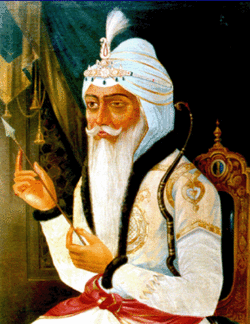
Rana Sanga, the indomitable Rajput king of Mewar, stood as a towering symbol of courage in 16th-century India. Born into a world of warring kingdoms, he united Rajput clans and waged relentless resistance against the rising Mughal Empire. His life, marked by epic battles and unyielding spirit, continues to inspire. This biography dives into the legacy of Rana Sanga, exploring his rise, wars, and enduring impact. Why does his story matter? Because it’s a testament to defiance against overwhelming odds, a lesson in resilience for today.
Early Life & Background
Born in 1482 as Sangram Singh Sisodia, Rana Sanga hailed from the illustrious Sisodia dynasty of Mewar. Growing up in the rugged Aravalli hills, he was steeped in Rajput values of honor, bravery, and loyalty. His father, Rana Raimal, ruled a fractured kingdom, and young Sanga witnessed the constant threat of rival clans and invaders. Trained in swordsmanship and strategy, he developed a fierce resolve to protect Mewar. By his teens, he was already leading skirmishes, earning the respect of his warriors.
Ascension to the Throne
In 1508, after his father’s death, Sanga ascended the throne of Mewar at age 26. His coronation was no mere formality; it was a call to unify a divided Rajputana. Mewar faced threats from neighboring kingdoms like Malwa and Gujarat, as well as the looming shadow of the Delhi Sultanate. Sanga’s early reign was marked by consolidating power, forging alliances, and rebuilding Mewar’s military might. His charisma and battlefield prowess earned him the title “Rana,” meaning “king of kings” among Rajputs.
Movement of Resistance to the Mughal Empire
Rana Sanga’s reign coincided with the arrival of Babur, the founder of the Mughal Empire. Unlike the Delhi Sultanate, Babur’s ambition was to establish a lasting empire in India. Sanga saw this as a direct threat to Rajput sovereignty. He rallied Rajput clans, including those from Marwar and Amber, to form a confederacy against Mughal expansion. His resistance wasn’t just military; it was a cultural stand to preserve Rajput traditions against foreign rule. Sanga’s defiance made him a folk hero, even as it drew Babur’s wrath.
Diplomatic Standoffs
Sanga was not only a warrior but a shrewd diplomat. He negotiated with rival kingdoms like Malwa and Gujarat, often playing them against each other to weaken their threat to Mewar. His most notable diplomatic move was inviting Babur to invade India to destabilize the Delhi Sultanate, only to later oppose him when Babur’s ambitions grew. This high-stakes gamble showcased Sanga’s strategic mind but also set the stage for his greatest battles. His ability to balance alliances and rivalries kept Mewar strong amidst chaos.
About Wars
Battle of Khanwa (1527)
The Battle of Khanwa was Rana Sanga’s most defining clash, fought against Babur’s Mughal forces on March 17, 1527. Leading a massive Rajput confederacy of 80,000 warriors, Sanga aimed to crush Babur’s smaller but disciplined army. Babur, fresh from his victory at Panipat, used advanced artillery and tactics, including tulughma (flanking maneuvers). Sanga’s forces charged with legendary courage, but the Mughal cannons inflicted devastating losses. Despite initial Rajput gains, Sanga was wounded, and his army faltered. The defeat was a turning point, cementing Mughal dominance in northern India. Yet, Sanga’s bravery inspired future resistance, and the battle remains a symbol of Rajput valor.
Battle of Bayana (1527)
Earlier in 1527, Sanga’s forces clashed with Babur’s army at Bayana, a prelude to Khanwa. Controlling the strategic fort of Bayana, Sanga aimed to disrupt Mughal supply lines. His Rajput cavalry overwhelmed Babur’s outpost, showcasing their superior horsemanship. However, Babur’s use of muskets and field fortifications turned the tide. The Rajputs suffered heavy losses, but Sanga’s tactical retreat preserved his army for Khanwa. This battle highlighted Sanga’s ability to adapt under pressure, even against technologically superior foes. It also exposed the Rajputs’ vulnerability to gunpowder warfare.
Battle against Malwa (1519)
In 1519, Sanga led Mewar against the Sultan of Malwa, Mahmud Khilji II, in a bid to secure Mewar’s southern borders. The Sultan’s army, bolstered by Gujarat’s support, outnumbered Sanga’s forces. Yet, Sanga’s guerrilla tactics and knowledge of the terrain led to a decisive victory at the Battle of Gagron. He captured Mahmud Khilji, but in a display of Rajput chivalry, released him after securing tribute. This victory expanded Mewar’s influence and solidified Sanga’s reputation as a formidable leader, paving the way for his later Mughal resistance.
Personal Life
Rana Sanga’s personal life was as intense as his battlefield exploits. He married several times, forging alliances with Rajput clans through matrimonial ties. His chief queen, Rani Karnavati, was known for her wisdom and later played a key role in Mewar’s politics. Sanga was a devoted father, raising his sons, including Udai Singh (father of Maharana Pratap), to uphold Rajput honor. Despite his warrior persona, he was a patron of poetry and music, finding solace in Mewar’s cultural traditions amidst constant warfare.
Management and Cultural Accomplishments
Sanga’s rule wasn’t just about war. He strengthened Mewar’s administration, improving irrigation systems and fortifying Chittorgarh, Mewar’s capital. His patronage of art and literature fostered a cultural renaissance, with poets composing epics in his honor. Sanga also revived ancient Rajput festivals, reinforcing cultural identity. His inclusive governance, respecting tribal and local leaders, ensured loyalty across Mewar’s diverse populace. These efforts made Mewar a beacon of Rajput pride, even as it faced existential threats.
Death and Succession
Rana Sanga’s life ended tragically in 1528, a year after Khanwa. Weakened by his wounds and betrayed by some allies, he was reportedly poisoned by his own nobles, who feared his relentless campaigns would doom Mewar. His death at age 46 shocked Rajputana, but his legacy endured. His son, Ratan Singh II, succeeded him, though Mewar faced challenges in the post-Sanga era. Sanga’s vision of Rajput unity lived on, inspiring future leaders like Maharana Pratap.
Legacy
Rana Sanga’s legacy is etched in India’s history as a symbol of resistance. His defiance against the Mughals inspired generations of Rajputs to fight for their independence. Today, he is celebrated in Rajasthani folklore, ballads, and festivals. Historians view him as a visionary who, despite defeat, laid the groundwork for Rajput resilience. His life reminds us that courage in the face of adversity can outshine even the greatest empires.
Controversies
Sanga’s life wasn’t without controversy. His decision to invite Babur to India, hoping to weaken the Delhi Sultanate, backfired when Babur turned against him. Some historians criticize this as a strategic blunder, arguing it hastened Mughal dominance. Additionally, his reliance on fractious Rajput alliances led to betrayals, notably at Khanwa. Yet, these controversies only humanize Sanga, showing the immense challenges he faced in a turbulent era.